Fats are compounds that include glycerol esters, fatty acids and bioactive substances. All fat-like substances are united by the scientific term lipids, which are substances with a fat-soluble molecule (fats, fatty acids, vitamins, phospholipids and others). The classification of lipids is based on their biochemical composition. There are complex (glycoside lipids, phosphatides, lipoproteins), cyclic (sterols or sterols and sterides) and simple lipids (triglycerides, cerols, microsides, cerols, squalenes, terpenes and others). To take the first step in the issue of proper balanced nutrition, we recommend Download FatSecret for Android tablet or smartphone, iPhone, iPad, other mobile devices. In the human body, lipids are concentrated in the subcutaneous tissue, in adipose and muscle tissue, liver and brain.
Of all the fats, three groups stand out in terms of importance for the functioning of the body: triglycerides, sterols and phospholipids. Triglycerides consist of four molecules: three fatty acids and glycerol. Fatty acids store energy. Sterols (sterol, or sterol, steroids) work as hormones. These are cholesterol, testosterone, cortisol and vitamin D. Phospholipids play a regenerative and structural role in the body, forming cell membranes. In food, phospholipids are found in large quantities in the liver, eggs, peanuts, wheat germ.
There are fat-soluble vitamins (A, D, E, K), which are stored in fatty tissues. It makes sense to chop carrots or pumpkin (vitamin A), as well as green leafy vegetables or cabbage (vitamin K) into a salad and season with fresh, unrefined, extra virgin vegetable oil.
Digestion of fats
The process of digesting fats begins with an enzyme contained in saliva. Then the enzyme of the pancreas comes into play. In the small intestine, fats are broken down into monoglycerides and fatty acids under the influence of bile, bile acids and the enzyme lipase. From 10 to 30% of fats are hydrolyzed in the stomach, and 70 to 90% are broken down in the duodenum and upper part of the small intestine. Final hydrolysis allows fats to pass through the intestinal cell walls and in the form of protein-coated fat droplets are transported throughout the body in the blood.
Fats are essential for the body to function, are used in cell membranes, hormones, and as an energy storage. In addition, accumulating under the skin and around organs as a protective cushion, fats provide thermal insulation and protection from damage.
Unsaturated and saturated fats
Fats can be of plant and animal origin, liquid and solid, unsaturated and saturated (with hydrogen atoms). As a rule, vegetable liquid fats consist of unsaturated fatty acids, and animal solid fats, such as butter or lard, of saturated ones.
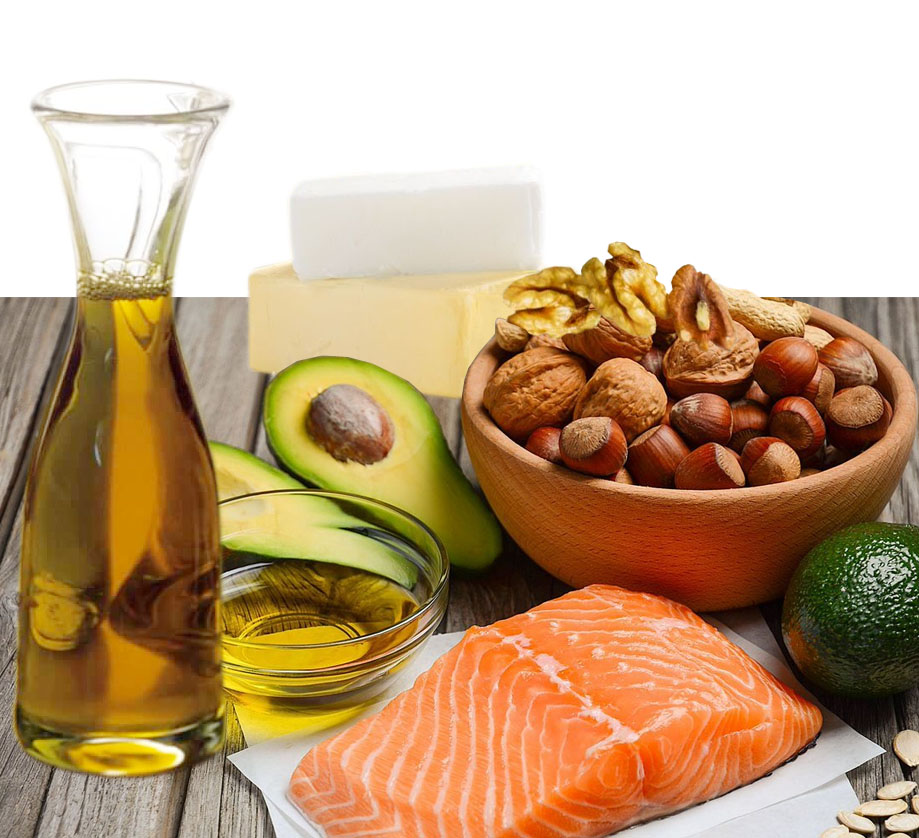
Pork and some other fats are classified as ointment-like. Since the beginning of the last century, there has been a special type of vegetable fats, artificially saturated with hydrogen atoms under special conditions, which have received the label “trans fat”. Next on https://antiage.click/en/fats-en we will figure out how these artificial pseudo-saturated fats are artificially created, in which products they are contained and why they are dangerous.
Fat consumption rate
With BJU 30-20-50 and daily caloric content of 2000 kcal, fats account for 400 kcal. In this case, according to WHO standards, the amount of saturated fatty acids should not exceed 200 kcal or 22 grams of pure saturated fat.
Lard, bacon, beef, chicken and other animal fats contain 44-47% monounsaturated, 4-22% polyunsaturated, 31-52% saturated fatty acids. Butter contains 25-35% monounsaturated, 2-6% polyunsaturated, 47-68% saturated fatty acids. Accordingly, the average person can afford up to 50 grams of oils and fatty foods with a high content of saturated fat daily.
Beef liver contains 3-4% fat, a whole chicken egg – 11%, rabbit meat – 11%, lamb and beef – 16% each, chicken – 18%, turkey – 22%, fatty pork – up to 50%. Accordingly, the average person can afford 300 grams of lamb or beef daily, but it is not advisable to consume more than 100 grams of fatty pork per day.
Thus, the norm for saturated fat consumption is conditionally implemented as follows: either 50 grams of lard (butter or other fat), or 100 grams of pork, or 300 grams of beef or lamb. In this case, it is also acceptable to season the salad with vegetable oil, given that it contains up to 15% saturated fat.
But the list below will clearly be too much: a sandwich with butter and cheese with coffee with cream in the morning, French fries and a Big Mac with cappuccino, Olivier salad with mayonnaise, bacon, lard, smoked sausage or another fatty delicacy during the day, a large piece of cake, a chocolate bar or a bag of oreshkov for a snack and pork neck shashlik with cognac for dinner.
Systematic overeating of fatty (as well as carbohydrate) food will inevitably lead to excessive deposition of subcutaneous and visceral fat, as well as fat storage in muscles and internal organs. It is recommended to calculate the norm of calories, proteins, fats, carbohydrates for yourself, adhere to a healthy diet and regularly engage in physical education or sports.
Trans fats
In addition to the above, additional harm to the body can be caused by the use of pseudo-saturated fats. P. Sabatier and V. Norman gave trans fats a “ticket to life”. Hydrogenated fats in the form of “Crisco Margarine” came to the food industry in the twentieth century with the help of the Procter & Gamble corporation. At the end of the twentieth century, it became known that trans fats are harmful to health.
Today, hydrogenated fat is industrially produced on the basis of cheap vegetable oil, such as palm, soybean or cottonseed, sometimes even technical vegetable oil. There is information about the production of hydrogenated technical fats from petroleum products. Under special conditions, under the influence of high temperature and accelerators, unsaturated liquid fat is saturated with hydrogen atoms and hardens, becoming pseudo-saturated. Accepting hydrogen, fatty acids change their spatial structure.
Such an industrially processed product now has the right to be called vegetable only conditionally, but this is what it is called everywhere on food labels. When the label simply says vegetable oil, without specifying what plant it is obtained from or by what method, it is trans fat.
This way, expensive natural butter can be replaced with cheap hydrogenated vegetable fat with a set of plasticizers, flavorings, and taste enhancers without the consumer noticing. Natural butter contains 2-8% trans fats, while margarine (or counterfeit butter) contains up to 70%.
The taste of dishes is determined not only by the quality of the main product, but also by the characteristics of the fat used. For example, beef fat is not suitable for baking rolls with apple jam or for cake. Butter gives a specific delicate and subtle taste to many dishes. Modern industrial chemistry allows us to cheaply create analogs of butter that are indistinguishable in taste, appearance and physical parameters based on hydrogenated vegetable fats.
In addition to counterfeit butter, chocolate, mayonnaise, sour cream and other dairy products, trans fats are found in products such as: cakes, pastries, cookies, waffles, gingerbread, pies, bagels, chocolate candies, chocolate, condensed milk and cream, ice cream, sauces, snacks, chips, processed meat, cutlets, dumplings, other semi-finished products and food in public catering networks. The highest content of trans fats is found in confectionery and cooking fats, milk substitutes and cocoa butter equivalents, non-dairy cream, ghee, spreads, margarines and similar products.
The wide use of trans fats in the food industry and catering was facilitated by their properties such as: cheapness, versatility, long shelf life, practical consistency, appetizing appearance.
First of all, the harm of trans fats to health is obvious at the level of any cell in the human body. Each cell is surrounded by lipids. In phospholipids that form cell membranes, standard fatty acid molecules can be imperceptibly replaced by trans isomers, which, due to their spatial shape, do not perform the function properly. If this process is widespread, the cell is damaged and fails.
Cells of the brain, heart, liver, and endothelium are especially sensitive to damage by artificial trans isomers. Associated disorders and diseases include: memory and cognitive impairment, unreasonable mood swings, unfounded aggression, stroke, myocardial infarction, thrombosis, and other cardiovascular diseases. Humans do not need and are not adapted to consuming trans fats.
Consuming trans fats, sugar, salt, flavor enhancers, and other food additives in large quantities causes digestive disorders, loss of appetite control, decreased insulin sensitivity, impaired insulin metabolism, excess body weight, and an increased risk of developing type 2 diabetes. Excess trans fats lead to decreased immunity and resistance to stress, oxidative stress, increased free radicals, development of chronic inflammatory processes, atherosclerosis, arthritis, many cardiovascular diseases, metabolic syndrome, obesity.
Chocolate, baked goods, confectionery, ice cream, butter, mayonnaise, sauces, soft and hard cheeses, condensed milk, cream, other dairy, fermented milk and other food products, culinary production and catering networks from natural ingredients have a pleasant natural taste, but quickly oxidize, lose their marketable appearance and spoil already on the counter. But counterfeit products of these products based on substitutes from cheap artificial trans fats and refined carbohydrates with modern flavors and flavor additives can lie on the shelves of supermarkets for a long time. Paying attention to the quality, texture, taste and shelf life of such products can significantly reduce the consumption of unhealthy trans fats.
It is impossible to reduce the harm of trans fats already absorbed by the body, there is no method for removing them from the body today. But this is not fatal. The life of most cells in the human body does not exceed 7 – 10 years, and many cells are renewed within a year or even faster. Thus, when giving up unhealthy food and switching to a healthy diet, you can notice an improvement in the appearance of hair, nails, epithelium and other positive changes within six months. Systematically and regularly engage in physical and cognitive activity, this optimizes metabolism and, along with it, cell regeneration.
The effect of saturated and pseudo-saturated fats on cholesterol levels
Saturated and pseudo-saturated fats increase the level of “bad” cholesterol. Cholesterol consists of fatty and amino acids. “Bad” cholesterol contains little protein, it is a low-density lipoprotein. It contributes to the formation of atherosclerotic plaques, which causes cardiovascular diseases. “Good” high-density lipoprotein contains a lot of protein and little fat. It removes unused cholesterol from cells and dissolves atherosclerotic plaques. Moderate consumption of animal fats is good for health. For frying food, use refined olive oil, butter, lard or animal fats.
Healthy fats
As for the healthiest unsaturated fats, the average person has a deficiency in them, sometimes so significant that in terms of negative impact on the body it is comparable to chronic vitamin deficiency.
There are only three groups of the most important unsaturated fats: monounsaturated omega-9 (oleic and other acids), polyunsaturated omega-3 (alpha-linolenic, eicosapentaenoic and docosahexaenoic and other acids (ALA, EPA, DHA)) and polyunsaturated omega-6 (linoleic, gamma-linolenic, dihomo-gamma-linolenic acid, arachidonic and other acids). There was even an outdated concept of “vitamin F”, consisting of a combination of oleic, arachidonic, linoleic and linolenic acids.
Olive, peanut and mustard oils, lard, and butter are rich in omega-9. In addition to fish oil, cod liver, northern fish, flax, nuts, sesame and linseed oils are rich in omega-3. Healthy omega-6 fats are found in unrefined sunflower and corn oils, pumpkin and sunflower seeds.
The optimal proportions for the body are omega-3 and omega-6 in the range from 1 to 1 to 1 to 4. Unfortunately, the average person does not get enough omega-3 from fatty fish and gets too much omega-6 from cheap vegetable oils. As a rule, the amount of omega-9 and omega-3 in the diet should be increased and the consumption of omega-6 should be significantly reduced. To do this, you should reduce the consumption of sunflower oil, deep-fried foods, fast food and periodically consume fatty fish, cod liver, fish oil, walnuts, sunflower and pumpkin seeds, other nuts and seeds, as well as olive and flaxseed oils.